Introduction
For many nursing students, the Intensive Care Unit (ICU) feels intimidating.
Monitors constantly beeping.
Oxygen lines.
Critical patients.
Emergency responses.
Even if you don’t plan to work in ICU immediately, understanding ICU basics is essential for every nurse.
Why?
Because modern hospitals expect nurses to understand critical care fundamentals — even in general wards.
If you are a final-year GNM or BSc Nursing student in Agra or a fresh graduate preparing for your first hospital job, this guide will help you understand what ICU readiness really means.
What Is the ICU and Why It Matters?
The Intensive Care Unit is designed for patients who require close monitoring and advanced medical support.
Patients in ICU may need:
- Continuous vital monitoring
• Oxygen therapy or ventilator support
• Emergency medications
• Rapid response to deterioration
While doctors lead treatment, nurses play a critical role in monitoring, documentation, and early detection of complications.
That is why ICU awareness is important — even for non-ICU nurses.
7 ICU Basics Every Nursing Student Should Know
- Understanding Vital Sign Monitoring
In ICU, every patient is connected to monitors displaying:
- Heart rate
• Blood pressure
• Oxygen saturation (SpO2)
• Respiratory rate
As a nurse, you must know:
What is normal?
What is abnormal?
When to escalate immediately?
Recognizing early warning signs can save lives.
2 – Oxygen Therapy Basics
Many fresh graduates feel unsure handling oxygen equipment.
You should understand:
- Nasal cannula vs face mask
• Oxygen flow rate basics
• Monitoring SpO2 levels
• When to inform the doctor
Even ward patients often require oxygen support.
Confidence in this area builds trust with senior staff.
3 – Basic Ventilator Awareness
You are not expected to manage ventilators independently as a beginner.
But you should know:
- Why ventilators are used
• Basic ventilator modes (introductory awareness)
• Alarm significance
• When to call senior staff
Fear reduces when familiarity increases.
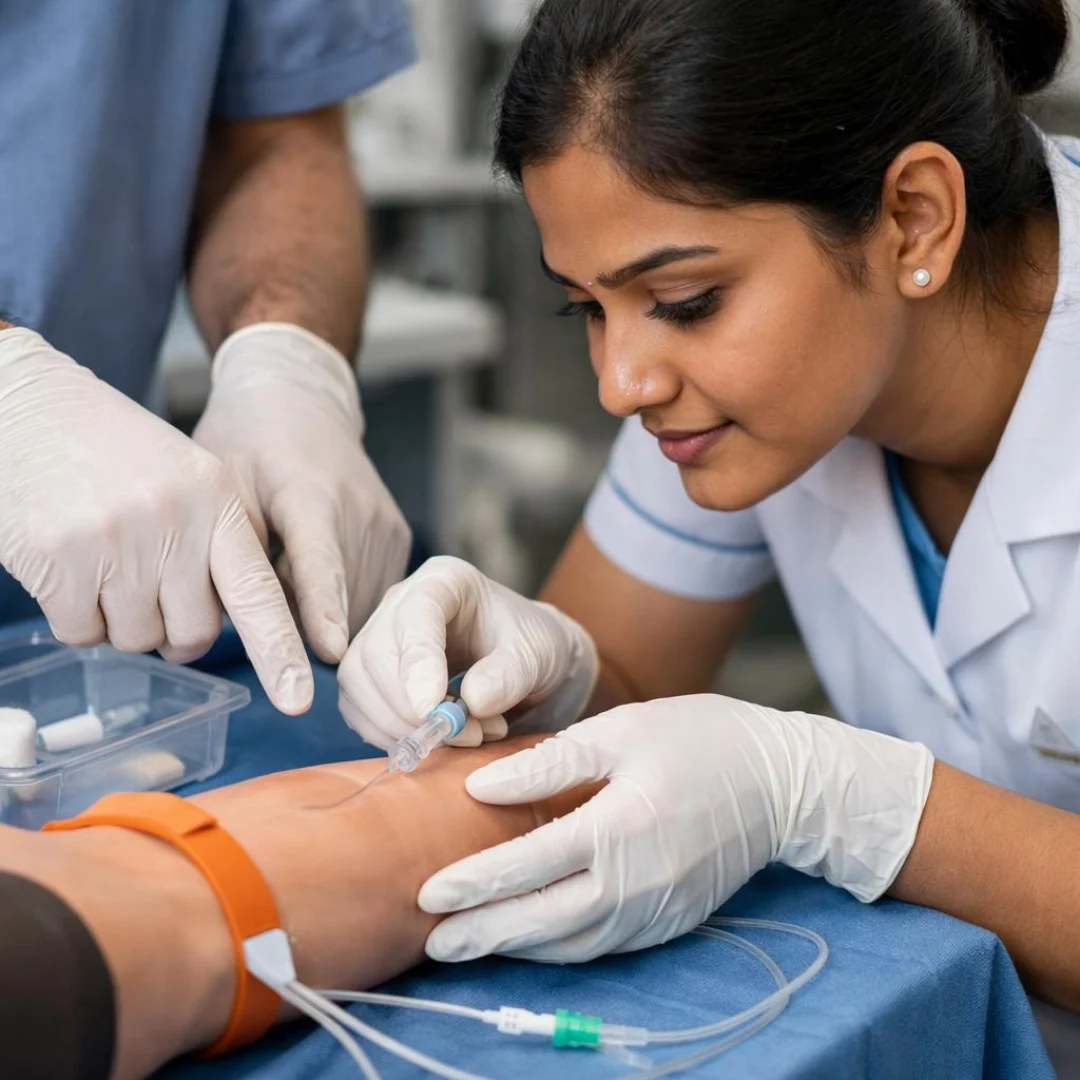
4 – IV Line and Drug Administration Accuracy
In ICU, drug administration errors can be dangerous.
You must be confident in:
- IV insertion
• Maintaining aseptic technique
• Infusion rate calculation
• Cross-checking medications
Repeated practical training improves precision.
5 – Infection Control Discipline
ICU patients are vulnerable to infections.
You must strictly follow:
- Hand hygiene
• PPE usage
• Sterile procedures
• Proper disposal protocols
Infection control is not optional — it is professional responsibility.
6 – Documentation Under Pressure
ICU documentation must be:
- Accurate
• Timely
• Legible
• Complete
You may need to record:
- Hourly vitals
• Medication administration
• Intake and output
• Patient response
Strong documentation skills protect both patient and nurse legally.
7 – Emergency Response Awareness
You must understand:
- What is Code Blue?
• Basic Life Support (BLS) steps
• CPR fundamentals
• Role of nurse during emergency
Even if you are assisting, your response time and clarity matter.
Emergency confidence comes from drills — not theory.
Why Many Nursing Students Feel Unprepared for ICU
Most nursing colleges provide theoretical ICU teaching.
But real confidence requires:
- Repeated hands-on practice
• Simulation-based emergency drills
• Exposure to monitoring systems
• Supervised practical sessions
Without repetition, knowledge remains theoretical.
That is where many fresh graduates struggle in their first hospital posting.
ICU Awareness and Nursing Careers in Agra
Healthcare facilities in Agra are expanding rapidly.
Private hospitals increasingly expect nurses to:
- Understand ICU basics
• Assist in critical care
• Respond quickly to patient changes
Students who demonstrate ICU awareness during interviews stand out immediately.
Practical knowledge increases employability.
How Practical Simulation Training Improves ICU Confidence
Simulation-based training allows students to:
- Practice CPR on mannequins
• Interpret monitor readings
• Handle mock emergency scenarios
• Practice documentation under supervision
• Experience real-duty simulations
When training replicates hospital conditions, fear reduces significantly.
Confidence is built through structured exposure.
Bridging the ICU Skill Gap
At HealBridge Academy in Agra, our 1-Month Nursing Excellence Program includes:
- ICU basics training
• Emergency drills
• Documentation practice
• Full shift simulations
• Professional discipline training
Our focus is not just theory revision.
Our goal is to help nursing students become hospital-ready with practical exposure.
We believe competence builds confidence — and confidence builds careers.
Final Thoughts
You do not need to be an ICU expert as a fresher.
But you must not be ICU-unaware.
Understanding ICU basics gives you:
- Professional confidence
• Better job performance
• Higher trust from doctors
• Stronger career growth potential
Before stepping into your first hospital role, ask yourself:
“Am I confident handling critical care basics?”
If not, structured practical training can make a significant difference.
Want to Build ICU Confidence?
HealBridge Academy
Agra
Explore our 1-Month Nursing Excellence Program focused on practical hospital readiness.
Limited seats per batch.





 HealBridge Academy